If you’re a teacher, you may have come across distracted children in the classroom. While the lessons are in progress, children may be staring out the windows, playing with stationery, or leaving their seats.
These signs are common in kids with Attention Deficit Hyperactivity Disorder (ADHD). Their minds are usually someplace else, not because they weren’t trying, but because they lost their attention span.
As an adult, you may think that they aren’t paying attention. But that’s how neurodivergent children are. They face a challenge in concentrating. And often their traits are reduced to laziness, ignorance, or lack of ability.
Even parents may not understand why their children are lagging behind despite their efforts. Well, to help these children become familiar with classroom situations, everyone needs to be empathetic and calm.
Observe and identify the root cause of their distraction and make effective classroom accommodations for ADHD children.
Such an approach will help the little ones get accustomed to the learning space and allow you to provide a strong educational experience.
If you’re looking for accommodations for ADHD kids in the classroom, then you’ve come to the right place.
This blog will explore classroom accommodations for neurodivergent kids and how they can support their learning and growth. It will also provide parental tips to support ADHD children at home.
How Does ADHD Affect Learning in Children?
For kids with ADHD, the brain develops and functions differently. They lack the attention skills that their peers of the same age may have. Hence, it affects their learning abilities.
Some kids may find it challenging to stay in one place in the classroom, while other children may be daydreaming. All of these cases boil down to the fact that they get distracted easily.
As teachers or parents, you should understand how ADHD affects children’s learning. It will allow you to build effective strategies for students with ADHD. That way, you can help your children learn and grow at their own pace.
Key ways ADHD affects learning in children:
- Executive dysfunction: ADHD students struggle to perform tasks and pay the required attention to schoolwork.
- Inattentiveness: Children with ADHD often have their minds elsewhere, leading to careless errors and incomplete tasks.
- Working memory deficits: Neurodivergent children often have difficulty concentrating, which impairs their ability to retain information for long, affecting their learning.
- Emotional regulation: These kids have sudden outbursts or may feel withdrawn. It therefore hinders their reading, listening, and problem-solving skills.
- Hyperactivity and impulsivity: ADHD kids don’t wait for their turn to answer. They often blurt out things and interrupt others, impacting the classroom environment.
Understanding Classroom Accommodations for ADHD Children
After understanding how ADHD affects learning in these children, schools should take appropriate measures to create an inclusive classroom environment. That’s when ADHD accommodations become crucial.
What are classroom accommodations for ADHD children?
Classroom accommodations are changes in teaching methods or classroom environments that allow ADHD kids to learn effectively. These changes focus on adjusting lessons, instructions, and task delivery that help children learn better, without altering the curriculum.
When it comes to teaching children with ADHD, you may find it a real challenge to bring their focus into the lessons. Instead of scolding or saying they are distracted, you can position their seat away from high-traffic areas, such as doors and windows.
School plans included in ADHD accommodations
If you’re a parent to an ADHD kid, you may know the challenge of positioning them in normal classroom situations. Distractions, constant foot-tapping, and daydreaming can affect your child’s grades.
So, how to ensure your child flourishes in a classroom environment? For that, schools provide 504 classroom accommodations for ADHD and an Individualized Education Program (IEP). These are educational plans that form an inclusive environment for children who process information differently.
Knowing the key differences between 504 plans and IEPs will help parents and educators understand how to create a safe learning space for neurodivergent kids.
The 504 plans in schools provide ADHD kids the same learning environment as their peers. These plans take their condition into account and allow educators to make classroom adjustments rather than changing the entire curriculum.
For instance, teachers can give ADHD kids more time to complete their assignments or tests. It will provide a positive classroom atmosphere, and the children can also complete their tasks at their own pace.
As for the IEP, it covers specialized learning that doesn’t fit the regular school curriculum. ADHD kids struggle to process information. They may also have issues understanding social cues. To ensure ADHD children thrive in school like the other children, an IEP has become a core element in schools.
For instance, kids with ADHD often answer questions quickly without waiting for their turn. In such cases, educators will establish a rule requiring students to raise their hands when answering questions. Initially, the kids may struggle following the instructions, which is why teachers must be patient with them.
Signs Your Child May Need Classroom Accommodations
As parents and educators, you should offer kids a safe learning space. That includes even those who process information differently.
Often, it’s challenging to tell whether children simply don’t want to learn or have issues. It is therefore essential to observe how they behave or react to situations.
Once you document your observations, the child can qualify for classroom accommodations. The following are the signs for classroom accommodations for ADHD children:
- Consistent struggle to keep up with peers.
- Difficulty in completing tasks or understanding subjects like maths.
- Inability to concentrate during structured assignments.
- Attention slipping away for a moment.
- Frustration or emotional outbursts related to school work.
- Trouble understanding verbal cues.
- Social withdrawal or difficulty in making friends.
Classroom Accommodations That Help Children With ADHD
Now that you know your children need assistance with school learning, introduce effective teaching methods that will make a difference. Instead of creating a restrictive atmosphere for ADHD children, make an inclusive space for them in the classroom.
As teachers, you need to observe these children and make necessary adjustments in the classrooms. Also, help them learn through activities they might understand to level up the playing field with their peers.
Here are the classroom accommodations for ADHD that will help children learn within their own abilities:
Introduce them to sensory games
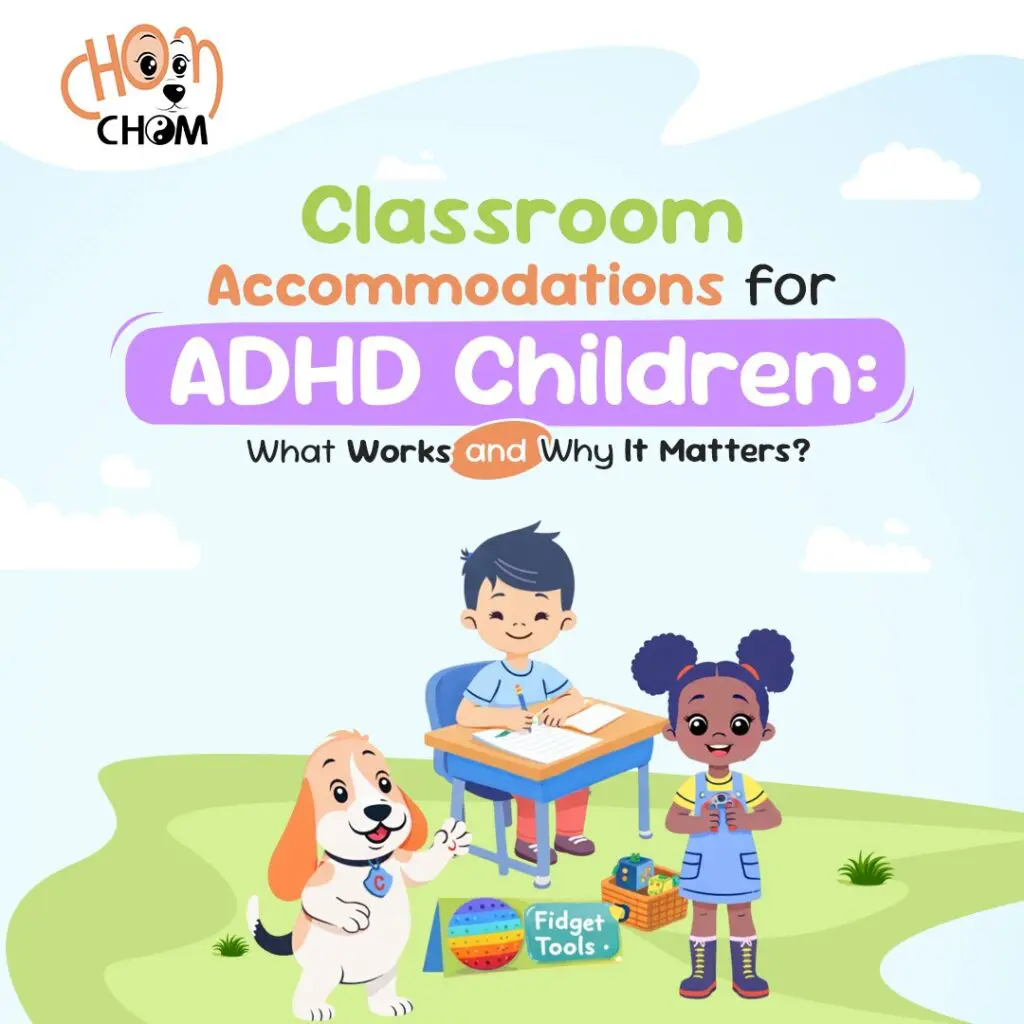
As an educator, you can offer a gamified session for children with ADHD. App-guided breathing exercises can help them better regulate their emotions. It will therefore ensure the kids stay in one place rather than fidget.
Games also include turn-taking activities that help hyperactive kids control their impulses. Through interactive tools, they can learn to wait their turn, which will help them become more aware of classroom situations.
Also, by introducing them to squishy playdough or tactile input, ADHD kids can learn to reduce distractions. Practicing these games will help reduce their outbursts and channel their focus into learning.
Break huge assignments into bite-sized tasks
Approaches to handling ADHD in schools include breaking down large assignments into smaller tasks. As parents or teachers, you know how difficult it can be for children to process huge amounts of schoolwork. It may lead them to daydream or lose motivation.
You can divide the larger assignments into smaller, manageable tasks. For instance, instead of asking kids to learn an entire poem, you can ask them to divide it into different stanzas.
These bite-sized tasks feel achievable for kids with ADHD. Without getting frustrated, they can learn the poem at their own pace and learn the entire poem.
Provide short and clear instructions
Many kids with ADHD struggle with remembering complex or long instructions. When you give multi-step directions all at once, they get confused. There is also a possibility that they may not remember most of the instructions.
You can break these instructions into short, clear steps. That way, they will know exactly what to do. Since their attention span is short, repeat the information and check whether they understand it.
These are effective ADHD school accommodations that can help children start and complete tasks independently. Moreover, it also creates a sense in ADHD kids that you are looking out for them.
Allot extra time for assignments and tests
Children with ADHD may take longer to complete tasks because they become distracted, lose track of time, or need extra effort to stay organized. Providing additional time for assignments and tests allows them to work at a comfortable pace.
ADHD children take longer to complete assignments because their minds are always somewhere else. As a result, they lose track of time. While most people may think they’re simply not paying attention, in reality, it is difficult for them to maintain focus for long.
It is therefore essential that teachers provide additional time for tests and assignments. It will allow them to accomplish the task at a comfortable pace.
Such accommodation allows the kids to think carefully about the answers. Also, it reduces anxiety in them, and they can demonstrate what they truly understand without rushing.
This accommodation ensures that their performance reflects their knowledge rather than their ability to manage time under pressure.
Provide preferential seating
Preferential seating means positioning a child in a location within the classroom that reduces distractions and increases engagement with teachers. For ADHD kids, it means to sit away from doors and windows and closer to the instructors.
As these children sit near the teacher, they receive subtle cues, guidance, or reminders when their attention may slip away. These accommodations for ADHD students in the classrooms also help teachers to monitor their progress and provide quick assistance when needed.
When educators reduce distractions, ADHD kids can concentrate better on lessons. Moreover, it helps them improve their listening skills and task completion.
Offer short breaks for movements
Children with ADHD often have high energy levels and may feel restless when required to sit still for long periods. Movement breaks allow them to release energy through short physical activities such as stretching, walking to the water fountain, or delivering a note to the office.
ADHD children often have high energy levels and may feel restless when they’re expected to sit in the classroom. By offering movement breaks, teachers can enable students to release their hyperactive energy.
They can encourage them to perform brief stretching or deliver a note to the office to help their brain reset.
After a short break, children with ADHD can concentrate better on their lessons. Also, they exhibit calm behavior, which increases attention span during lessons.
Reduce homework load
After a long school day, children with ADHD may find it extremely challenging to sit and complete prolonged homework. In the classroom, accommodations for ADHD can reduce the homework load.
Highlight the essential concepts and practices they have to learn to reduce burnout. As a teacher, your goal should be to prioritize quality learning over quantity of work.
By reducing homework, you’re allowing the kids to take on manageable tasks. It will reduce their anxiety or fear in the classroom learning.
Why Classroom Accommodations Matter for Children With ADHD?
After learning about the various classroom accommodations for ADHD, it’s crucial to understand their significance. As a teacher, you will find curious children struggling to learn in traditional school environments that require sustained attention, organization, and sitting still.
Accommodations help overcome these barriers, allowing kids to focus on learning rather than constantly trying to manage their challenges. When you implement such supportive strategies, you get the opportunity to participate in classroom activities and discover their true potential.
Here’s why classroom accommodations matter for ADHD kids:
Strengthens focus and participation
Children with ADHD find it difficult to stay attentive during lessons, especially in classrooms with many distractions. With movement breaks and preferential seating, you can reduce these distractions for children and improve concentration.
As the distractions are limited, children focus during lessons. As a result, they show active participation in the classroom, be it by answering questions or completing tasks.
Improves academic performance
Completing homework or keeping up with classroom tasks can be daunting for children with ADHD. To ensure they can learn to their abilities, a structured learning style can be helpful.
Consider providing clear instructions, extra time, and breaking down the homework into smaller parts. Such accommodations are likely to suit the learning abilities of children with ADHD. That leads to better grades and an overall academic experience.
Builds confidence
As children with ADHD face repeated academic struggles, they tend to lose motivation in school learning. It leads to a loss of confidence in them. Through classroom accommodations such as positive reinforcement, children have the opportunity to thrive.
It also helps change their perception of teachers, and they feel more confident to participate in activities. As they gain motivation and confidence, they learn new ideas and lessons better.
Supports emotional well-being
As attention slips away in ADHD children, adults may interpret their behavior as laziness or ignorance. That makes these kids feel misunderstood. Supportive accommodations enable teachers to respond to their needs in a more constructive and understanding way.
Through app-guided breathing activities and other sensory games, educators can reduce anxiety and emotional outbursts in children. It thus makes them feel valued rather than punished.
Tips for Parents Supporting ADHD Children at Home
While classroom accommodations can greatly support children with ADHD, the strategies used at home also play an important role in helping them succeed. Creating a supportive and structured environment at home can reinforce what your child learns at school and make daily tasks more manageable.
While accommodations for ADHD in the classroom greatly support children, it is essential to know how to establish a supportive environment at home. If you’re a parent to an ADHD kid, you might know their hyperactivity can interfere with their learning.
Often, that makes you scold them, which only makes the situation worse. To help them learn at home, you can consider the following tips:
- Set a fixed homework time and quiet study space. A consistent routine helps ADHD children mentally prepare and reduces distractions.
- Praise your children for their achievements. When they complete the bite-sized tasks, say that they’re doing well. It will motivate them to learn more and level up with their peers.
- Stay in touch with their educators to track progress and challenges. It will help you better understand their behavior, allowing you to create a more comfortable space for your children to learn.
- Ensure you create a calming, nurturing environment for your children. That way, the kids can be more attentive and learn better.
Help Your Little One Thrive in Classroom Activities with ChomChom Tech Sensory Games
Classroom accommodations for ADHD can help children better understand their lessons. Making them sit in quiet spaces and reducing homework load can create a distraction-free learning environment.
Another effective way to improve their concentration is to introduce game-based learning. It helps children practice retaining attention through an enjoyable experience.
At ChomChom Tech, we offer a gamified platform guiding how to help a distracted child in the classroom. Our ADHD-friendly games improve the child’s memory, enhancing their academic performance.
Even parents can encourage children to play these bite-sized, visually appealing games to calm their minds. That way, they can boost children’s creative and problem-solving abilities, offering a better learning solution.
Download the games from our website to help your kids grow attention and reduce distractions.